NASA’s Perseverance Rover Completes a Marathon on Mars: Why This Milestone Matters Beyond the Distance
For more than five years, NASA’s Perseverance rover has been steadily exploring the surface of Mars. It has now crossed another symbolic milestone by travelling the equivalent of a full marathon on the Red Planet. While the distance itself may sound like a fun achievement, scientists say it reflects the rover’s durability, navigation capabilities, and its continuing role in studying whether ancient Mars could once have supported life.
What Happened?
NASA has confirmed that the Perseverance rover has travelled more than 42.195 kilometres (26.2 miles) across Mars, matching the length of a standard marathon. The milestone was reached after approximately five years and four months of operations following the rover’s landing in Jezero Crater in February 2021.
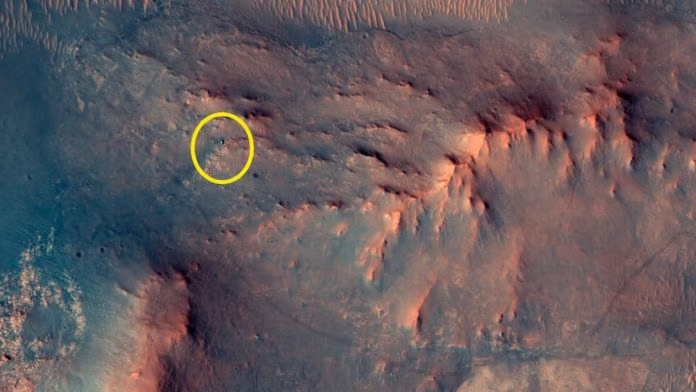
To mark the achievement, NASA released an image captured by the Mars Reconnaissance Orbiter. In the photograph, Perseverance appears as a tiny green speck, while its tracks stretching across the Martian landscape reveal the long route it has travelled.
How Credible Is This News?
This is a confirmed scientific development.
The milestone has been officially announced by NASA and supported with orbital imagery from the Mars Reconnaissance Orbiter. Independent science publications have also reported the event based on NASA’s data. There are currently no significant disputes regarding the achievement itself.
Why Is a Marathon on Mars Significant?
The marathon comparison is symbolic rather than athletic, but it highlights an important engineering accomplishment.
Driving even a few metres on Mars is far more difficult than driving on Earth. The rover must navigate rocky terrain, steep slopes, loose soil and unpredictable obstacles while operating millions of kilometres away from mission controllers. Commands often take several minutes to reach Mars because of the distance between the two planets, meaning Perseverance frequently makes navigation decisions on its own using onboard software.
Covering more than 42 kilometres under these conditions demonstrates the rover’s reliability and the effectiveness of NASA’s autonomous driving technology.
The Bigger Scientific Mission
Distance is not the mission’s primary goal.
Perseverance was sent to Jezero Crater because scientists believe it once contained an ancient lake and river delta billions of years ago. These environments are considered among the most promising places to search for signs that microbial life may once have existed.
During its journey, the rover has been:
- Collecting rock and soil samples for possible future return to Earth.
- Studying the geology of ancient Martian landscapes.
- Investigating the planet’s past climate.
- Looking for chemical and geological evidence that could indicate ancient microbial life.
Scientists caution that while some samples appear promising, no confirmed evidence of past life has been found. Any definitive conclusions would require detailed laboratory analysis on Earth.
How Does Perseverance Compare With Earlier Mars Rovers?
NASA has operated several successful Mars rovers over the past two decades, each contributing to the understanding of the Red Planet.
Perseverance reached the marathon distance considerably faster than the Opportunity rover, which previously achieved the same milestone after more than 11 years of exploration. The quicker progress reflects improvements in rover design, navigation systems and mission planning rather than simply higher speed.
The rover also benefits from technologies developed through previous Mars missions, allowing it to travel more efficiently while continuing scientific observations.
Who Benefits From This Mission?
Although no single industry directly benefits from this milestone, the broader impact extends across several areas.
Scientific community
- Gains new geological data and environmental observations from Mars.
- Receives additional rock samples that may answer long-standing questions about the planet’s history.
Space agencies
- NASA can test technologies that could support future robotic and human missions.
Technology sector
- Advances in autonomous navigation, robotics and remote operations developed for space missions often influence technologies used on Earth over time.
Education and research
- Universities and research institutions gain access to valuable mission data for scientific studies.
There are no immediate negative economic or political consequences linked to this development.
What Could This Mean for Future Mars Exploration?
The milestone reinforces confidence in long-duration robotic missions.
As Perseverance continues exploring older rock formations beyond Jezero Crater, scientists hope it will collect additional samples that improve understanding of early Mars.
The mission also contributes valuable experience for future exploration efforts, including:
- Advanced autonomous rover systems.
- Future Mars sample-return initiatives.
- Planning for eventual human missions to Mars.
However, these larger goals remain long-term projects and depend on future funding, international cooperation and technological progress.
How Are Experts and Space Agencies Responding?
NASA has presented the marathon milestone as an illustration of the rover’s continued health and operational success rather than its final objective. Scientists remain focused on the mission’s scientific discoveries, particularly the collection of carefully selected rock samples.
Space researchers generally view the achievement as evidence that Perseverance is continuing to perform well years beyond its original landing, allowing more ambitious exploration of previously inaccessible terrain.
What Should Readers Expect Next?
Perseverance’s work is far from complete.
The rover will continue exploring regions west of Jezero Crater, examining some of Mars’ oldest rocks and collecting additional samples. Scientists are expected to release further findings as new geological analyses become available.
Any breakthrough regarding ancient life on Mars, however, would require extensive scientific verification and would not be based on a single observation or sample.
Key Takeaways
- NASA’s Perseverance rover has officially travelled the equivalent of a full marathon on Mars, marking another engineering milestone in planetary exploration.
- The achievement reflects the rover’s durability and advanced navigation systems, but its primary mission remains the search for clues about Mars’ ancient environment and possible past microbial life.
- Scientists expect Perseverance to continue exploring new terrain and collecting samples that could shape future Mars research for years to come.