Congress Signals Support for Sonam Wangchuk Protest While Balancing Its Political Strategy
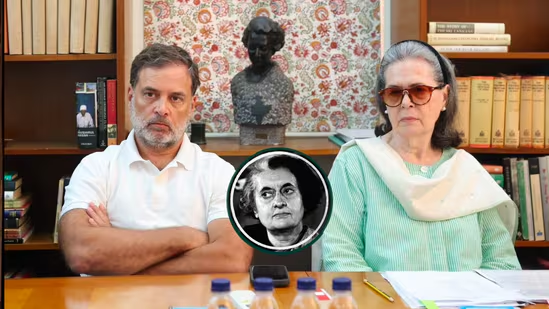
The Congress party has publicly shown support for activist Sonam Wangchuk’s ongoing protest in Delhi, marking a noticeable shift after remaining largely silent for several weeks. The development has drawn attention not only because of the protest itself but also because it reflects how India’s main opposition party is trying to balance political messaging, historical legacy, and electoral strategy.
What Has Happened?
Congress leaders have now openly expressed solidarity with Sonam Wangchuk, who has been on a prolonged hunger strike at Jantar Mantar. Senior party leader Pawan Khera visited the protest site, making it the party’s first official appearance alongside the movement.
The protest has focused on issues including demands related to education governance and accountability, while also raising broader concerns about democratic engagement and public dialogue. Congress leaders have reiterated that they have already been demanding accountability from the Union government on similar issues, particularly regarding education-related controversies.
How Credible Is This Development?
The Congress party’s support is confirmed through official statements and public appearances by its leaders. Similarly, Sonam Wangchuk’s hunger strike and the protest at Jantar Mantar have been widely reported by multiple national news organisations.
However, reports describing internal discussions within the Congress about when and how to support the protest are largely based on information from party sources rather than official party documents. These aspects should therefore be viewed as reported political assessments rather than independently verified facts.
Why Is This Politically Significant?
The timing of Congress’ support matters because the party had initially stayed away from the protest despite several opposition leaders extending their backing earlier.
Political observers believe the Congress faced a strategic dilemma:
- Supporting the protest could strengthen its image as a defender of democratic protests.
- At the same time, the party also wanted to maintain its own political identity rather than appear to be following another movement’s agenda.
The eventual decision to publicly engage suggests the Congress believes the issues raised by Wangchuk now overlap with its own campaign against the central government, particularly on education-related concerns.
The Historical Context Behind the Move
One reason this development has attracted attention is the historical connection involving former Prime Minister Indira Gandhi.
In 1984, Indira Gandhi reportedly intervened during a hunger strike led by Sonam Wangchuk’s father, Sonam Wangyal, over demands concerning Ladakh. That episode has resurfaced in current political discussions, with reports suggesting that Congress leaders viewed it as part of the party’s historical approach of engaging with peaceful protests rather than ignoring them.
While the circumstances today are very different, the reference illustrates how political parties often use historical events to explain or justify present-day decisions.
Rahul Gandhi’s Different Approach
Interestingly, Rahul Gandhi has not personally visited the protest site.
Instead, he has continued raising similar issues through the Congress party’s separate student outreach campaign, where he has focused on questions surrounding education policy and alleged examination irregularities.
This has led to criticism from some supporters of the protest, while Congress leaders argue that supporting an issue does not necessarily require participating in every protest event.
What Does the BJP Say?
The BJP-led central government has not accepted the demands being made by the protesters and has maintained its own position on the issues involved.
As with many politically sensitive protests, both the government and opposition are presenting different narratives about the movement’s significance and objectives. Readers should recognise that these competing political interpretations form part of India’s wider democratic debate.
Who Could Be Affected?
The immediate impact is political rather than economic.
Stakeholders include:
- Opposition parties attempting to build public support.
- The BJP government, which continues to face criticism over education-related issues.
- Students and young voters, who remain a major focus of political campaigns.
- Civil society groups advocating greater government engagement with peaceful protests.
If the issues raised by the protesters continue gaining public attention, they could influence political discussions during the upcoming parliamentary session.
What Could Happen Next?
Several developments are worth watching:
- Whether more opposition parties formally join the protest.
- Whether the central government opens dialogue with the protesters.
- Whether Parliament sees renewed debate over education governance and related demands.
- Whether Congress expands its participation beyond symbolic support.
At present, there is no official indication that the government plans to alter its position, making future political negotiations uncertain.
Analysis: Why This Matters Beyond One Protest
Beyond the immediate headlines, the episode highlights how modern political parties balance activism with electoral strategy.
Congress appears to be supporting the broader issues raised by the protest while maintaining an independent political campaign. This allows the party to align with public concerns without becoming entirely dependent on another movement’s leadership.
For the government, the challenge remains managing criticism while maintaining its policy position. For protesters, sustained public attention will likely be crucial if they hope to influence political decision-making.
The coming weeks may determine whether this remains a symbolic political moment or develops into a larger national debate.
Key Takeaways
- Congress has officially expressed support for Sonam Wangchuk’s protest after initially keeping its distance.
- The party is attempting to balance historical legacy, opposition politics, and its own independent campaign strategy.
- The government’s response and developments during the upcoming Parliament session will likely determine the next phase of this political issue.