World’s Most Expensive Dinosaur Fossil Sells for Record $50.1 Million: Why the Auction Is Sparking a Bigger Debate
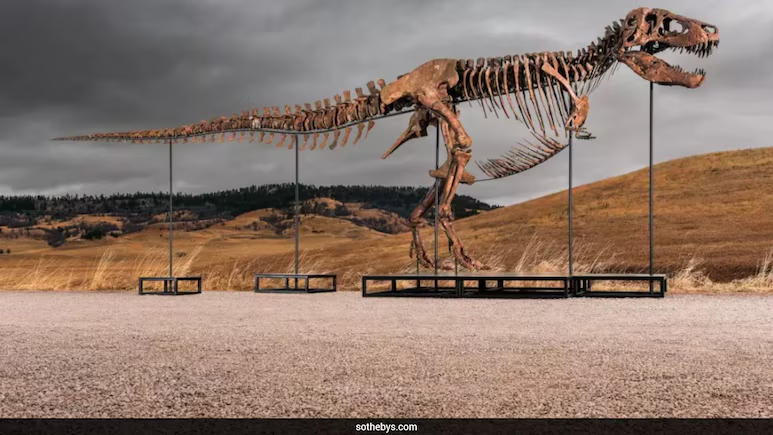
A 67-million-year-old Tyrannosaurus rex fossil has become the most expensive dinosaur skeleton ever sold at auction after fetching a record $50.1 million in New York. While the sale has attracted global attention because of its price, it has also revived an important discussion about whether rare fossils should remain in private collections or be preserved in public museums.
What Happened?
A mounted Tyrannosaurus rex skeleton, popularly known as “Gus,” was sold at a Sotheby’s auction in New York for $50.1 million after an intense bidding contest involving seven buyers. The auction lasted around ten minutes before an anonymous bidder secured the fossil, setting a new world record for the highest amount ever paid for a dinosaur skeleton at auction.
According to Sotheby’s, Gus is among the largest and most complete T. rex specimens discovered. The fossil was unearthed on private land in South Dakota in 2021 and consists of 183 fossilized bones. Scientists estimate the dinosaur lived roughly 67 million years ago, near the end of the age of dinosaurs.
The sale surpassed the previous auction record, which was held by the Stegosaurus fossil “Apex,” sold for $44.6 million in 2024.
How Credible Is This News?
This is a confirmed development.
The sale was officially conducted by Sotheby’s, and the final auction price has been reported by multiple established international news organizations. The identity of the buyer has not been publicly disclosed, but the auction results themselves are not in dispute.
Why Does This Matter?
The record-breaking price is significant for more than just the auction market.
Rare dinosaur fossils are scientifically valuable because they help researchers understand prehistoric ecosystems, animal evolution, and Earth’s geological history. Every well-preserved specimen has the potential to provide new information that may not be available from previously discovered fossils.
At the same time, fossils have increasingly become high-value collectibles, attracting wealthy private buyers alongside museums and research institutions. As prices continue to rise, many scientists worry that important discoveries could become inaccessible for future research if they remain in private ownership.
The Debate: Private Ownership vs Public Science
The auction highlights a long-running disagreement between commercial fossil collecting and scientific research.
Supporters of private ownership argue that:
- Fossils discovered on privately owned land can legally be bought and sold in the United States.
- Commercial excavation often helps recover fossils that might otherwise remain buried or deteriorate.
- Private collectors sometimes loan or donate important fossils to museums.
Critics, including many paleontologists, believe:
- Rare fossils are part of Earth’s natural heritage.
- Scientific discoveries benefit most when specimens remain accessible to researchers.
- Museums often cannot compete financially with billionaire collectors in international auctions.
Who Benefits and Who Could Be Affected?
Potential beneficiaries
- Auction houses handling rare natural history collections.
- Landowners who legally own fossil-bearing property.
- Private collectors seeking historically significant specimens.
- The growing market for rare scientific collectibles.
Those facing challenges
- Museums operating with limited acquisition budgets.
- Researchers who may lose access to scientifically important specimens.
- Educational institutions if major fossils remain unavailable for public display.
Economic and Scientific Impact
The sale demonstrates that dinosaur fossils are increasingly being treated as premium collectible assets, similar to fine art or rare historical objects.
Higher auction prices could encourage additional fossil exploration on privately owned land. However, they may also increase competition between commercial buyers and publicly funded museums.
Scientists say the long-term impact will depend on whether privately owned fossils continue to be made available for research through loans or public exhibitions.
How Are Different Stakeholders Responding?
Auction organizers have described the sale as evidence of growing global interest in natural history collections.
Many paleontologists have expressed concern that scientifically valuable fossils may become harder to study if they disappear into private collections.
Collectors generally view legally acquired fossils as valuable historical artifacts that deserve preservation, regardless of ownership.
The wider public response has largely focused on the extraordinary price paid for a prehistoric animal that became extinct millions of years ago, while the scientific community continues to emphasize the importance of balancing commercial interests with research access.
What Could Happen Next?
The sale is unlikely to change fossil ownership laws immediately, but it is expected to renew discussions about how scientifically important discoveries should be preserved.
Experts may continue advocating for stronger partnerships between private collectors and museums, including long-term loans that allow researchers and the public to study rare specimens without preventing private ownership.
Whether future record-breaking fossil sales follow this model remains uncertain.
Key Takeaways
- A Tyrannosaurus rex fossil named “Gus” has become the world’s most expensive dinosaur skeleton after selling for $50.1 million at a Sotheby’s auction.
- While the sale is fully confirmed, it has reignited an ongoing debate over whether rare fossils should remain in private collections or be preserved for scientific research and public education.
- The growing commercial value of dinosaur fossils is likely to influence future auctions, museum acquisitions, and discussions about balancing private ownership with scientific access.