Argentina’s Falklands Banner Celebration After England Win Sparks FIFA Debate: What Happened and Why It Matters
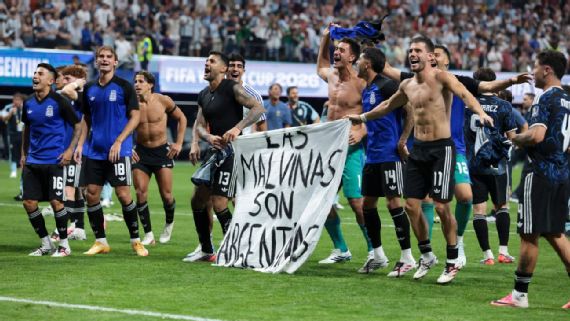
Argentina’s dramatic victory over England in the FIFA World Cup semifinal has become the center of attention for reasons extending beyond football. While the team celebrated reaching another World Cup final, several players were seen displaying a banner reading “Las Malvinas son Argentinas” (“The Malvinas are Argentine”), referring to the disputed Falkland Islands.
The incident has reignited discussion about the long-running sovereignty dispute between Argentina and the United Kingdom while also raising questions about FIFA’s rules on political messages during official football events.
What Happened?
Argentina defeated England 2-1 in the FIFA World Cup semifinal after a late comeback to secure a place in the tournament final. Shortly after the final whistle, some Argentine players celebrated with a banner carrying the message “Las Malvinas son Argentinas.” The slogan reflects Argentina’s long-standing claim over the Falkland Islands, known domestically as Las Malvinas.
The celebration quickly attracted global attention because the islands remain the subject of a decades-long territorial dispute between Argentina and the United Kingdom.
How Credible Is This News?
The incident is well documented through photographs, television broadcasts, and reports from multiple international media organisations. The banner was publicly displayed during Argentina’s on-field celebrations following the semifinal victory.
However, at the time of writing, FIFA has not announced any disciplinary decision regarding the incident. Reports suggesting possible sanctions remain based on FIFA’s existing regulations rather than a confirmed punishment.
Why Is the Banner Controversial?
The Falkland Islands have been administered by the United Kingdom since the 19th century, while Argentina continues to claim sovereignty over the territory and refers to it as Las Malvinas.
The dispute escalated into armed conflict during the 1982 Falklands War, making the issue deeply emotional in both countries. As a result, football matches between Argentina and England often carry historical and political significance beyond the sport itself.
Although many Argentine citizens consider the slogan a patriotic statement, the issue remains politically sensitive internationally.
FIFA’s Rules on Political Messages
FIFA generally prohibits political, religious, or ideological messages from being displayed during official competitions. These regulations are intended to keep football separate from political disputes and ensure tournaments remain focused on sport.
The current controversy has therefore prompted discussion over whether the banner could be considered a breach of those rules.
It is important to note that no official disciplinary outcome has yet been confirmed.
Background: Football and the Falklands Issue
This is not the first time football has intersected with the Falklands dispute.
Previous Argentina-England encounters have often been viewed through the lens of history, particularly following the 1982 conflict. Diego Maradona’s famous performances against England in the 1986 World Cup further strengthened the symbolic nature of the rivalry for many supporters.
Because of this background, even symbolic gestures made after matches can attract international attention.
Who Could Be Affected?
Several groups could be impacted if FIFA decides to investigate the incident.
Argentina’s Football Association
- Could face disciplinary proceedings if FIFA determines tournament regulations were violated.
Players
- Depending on FIFA’s findings, sanctions could range from warnings to financial penalties or other disciplinary measures, although no such action has been announced.
FIFA
- The governing body may face increased scrutiny over how consistently it applies rules concerning political expressions during international tournaments.
Supporters
- Fans from both Argentina and England continue to interpret the incident through very different historical and national perspectives.
Different Reactions So Far
The incident has generated mixed responses internationally.
Some Argentine supporters have defended the banner as an expression of national identity and historical belief.
Many critics, particularly in the United Kingdom, argue that political messages should not appear during FIFA competitions and have called for equal enforcement of tournament regulations.
Football observers have also debated whether governing bodies should treat all political demonstrations consistently, regardless of the country involved.
Analysis: Why This Matters Beyond One Match
Analysis
This episode illustrates how international sporting events can quickly become platforms for wider political and historical debates.
Although the match itself was decided on the field, the post-match celebrations shifted public discussion toward geopolitics and FIFA’s responsibility to enforce its own rules consistently.
The incident also highlights the challenge facing global sporting organisations: balancing freedom of expression, national identity, and the principle of keeping international competitions politically neutral.
Whether FIFA ultimately takes disciplinary action may influence how future political gestures are handled during major tournaments.
What Happens Next?
Several developments are possible over the coming days:
- FIFA may review the incident under its disciplinary framework.
- Argentina’s Football Association could be asked to provide its explanation if formal proceedings begin.
- If FIFA decides no rules were violated, the matter may end without sanctions.
- If action is taken, it could become another reference point for future cases involving political messages during international football events.
Until FIFA issues an official statement, the outcome remains uncertain.
Key Takeaways
- Argentina’s post-match celebration included a banner supporting its claim over the Falkland Islands, creating international controversy after the World Cup semifinal victory over England.
- FIFA prohibits political messages during official competitions, but no disciplinary decision has yet been announced.
- The incident reflects how historic territorial disputes can continue to influence international football, even after the final whistle.