Badrinath Donation Theft Case: Temple Employee Arrested as Investigation Deepens
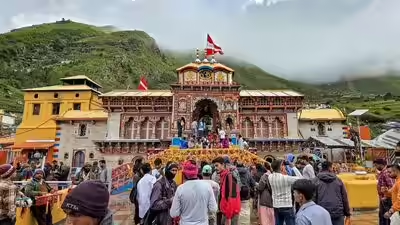
The investigation into alleged irregularities involving donations at Uttarakhand’s Badrinath temple has reached a new stage with the arrest of a suspended temple committee employee. Authorities say the move is part of an ongoing probe into claims that money offered by devotees was improperly handled.
While the arrest marks an important development, investigators are continuing to examine the full extent of the alleged financial misconduct and whether others may also have played a role.
What Happened?
Uttarakhand Police have arrested Pramod Nautiyal, a suspended employee of the Shri Badrinath-Kedarnath Temple Committee (BKTC), in connection with the alleged theft and misappropriation of donations received at Badrinath Dham.
According to police officials, Nautiyal was taken into custody from his residence in Dehradun and brought to Badrinath for further investigation. His arrest follows an FIR registered earlier this month after a preliminary internal inquiry by the temple committee reportedly found signs of financial irregularities in the handling of devotees’ offerings.
Authorities have not announced the final findings of the investigation, and the case remains under active examination.
How Credible Is This News?
This is a confirmed development.
The arrest has been officially confirmed by Uttarakhand Police and has been reported by multiple established news organisations. Earlier, the BKTC suspended the employee after its preliminary inquiry reportedly found prima facie evidence of irregularities. The Uttarakhand government also constituted a separate high-level committee to conduct an independent inquiry into the matter.
However, the investigation has not yet concluded. An arrest should not be interpreted as proof of guilt, and any criminal liability will ultimately be determined through the legal process.
Background: Why Is This Case Important?
Badrinath is one of India’s most significant Hindu pilgrimage destinations and attracts millions of devotees each year. Donations made at the temple help support religious activities, maintenance, pilgrim services and administrative operations.
Because these offerings are made voluntarily by devotees, transparency in how funds are collected, counted and managed is critical for maintaining public trust.
The controversy surfaced after allegations emerged regarding irregularities during the counting of temple offerings, prompting both departmental and government-level investigations.
Why Does This Matter?
The case extends beyond the alleged actions of one individual.
If investigators establish weaknesses in the management of donations, it could raise broader questions about financial oversight within religious institutions that receive substantial public contributions.
The investigation also highlights the importance of:
- Transparent accounting of donations.
- Secure collection and counting procedures.
- Independent auditing of temple finances.
- Strong internal monitoring mechanisms.
For devotees, confidence that donations are used for their intended purpose is an essential part of maintaining faith in institutional management.
Who Is Affected?
Devotees
People who contribute financially to the temple expect their offerings to be managed responsibly. Allegations of financial misconduct may reduce public confidence until investigations are completed.
Temple Administration
The BKTC faces increased scrutiny regarding its internal controls, supervision and accountability procedures.
Government Authorities
The Uttarakhand government may face pressure to strengthen oversight of religious institutions that handle large volumes of public donations.
Local Economy
Badrinath’s pilgrimage economy supports hotels, transport operators, shopkeepers and local businesses. While there is no indication that the current investigation has affected pilgrimage activity, maintaining public confidence remains important for the region’s tourism sector.
Possible Immediate and Long-Term Impact
Although the investigation is ongoing, several outcomes are possible if irregularities are confirmed:
Immediate developments could include:
- Continued police investigation.
- Examination of financial records.
- Questioning of additional witnesses or officials.
- Internal disciplinary proceedings.
Longer-term changes may include:
- Stronger financial audits.
- Improved CCTV and monitoring during donation counting.
- Digital record-keeping for temple finances.
- Revised administrative procedures for handling offerings.
Any policy changes will depend on the findings of both the police investigation and the government-appointed inquiry committee.
How Are Stakeholders Responding?
The BKTC has already suspended the employee named in the case and initiated an internal inquiry.
Separately, the Uttarakhand government has directed the temple committee to take action against officials identified during the inquiry process while continuing its own independent investigation.
Police continue to investigate the matter, and officials have indicated that the probe remains active.
What Should Readers Expect Next?
The arrest is unlikely to mark the end of the investigation.
Readers should expect:
- Further questioning of those connected to donation management.
- Review of financial documents and evidence.
- Findings from the government-appointed inquiry committee.
- Possible additional legal or administrative action if supported by evidence.
Until investigators complete their work, many details—including whether others may be implicated—remain unconfirmed.
Key Takeaways
- A suspended BKTC employee has been arrested in connection with the alleged mishandling of donations at Badrinath temple, marking a significant step in the ongoing investigation.
- The case has triggered both police and government inquiries, with officials examining whether existing systems for handling temple donations require stronger safeguards.
- The investigation is still underway, and final conclusions will depend on the evidence presented through the legal and administrative processes