NASA Confirms Near-Earth Object 1998 SH2 Is Actually a Comet, Not an Asteroid
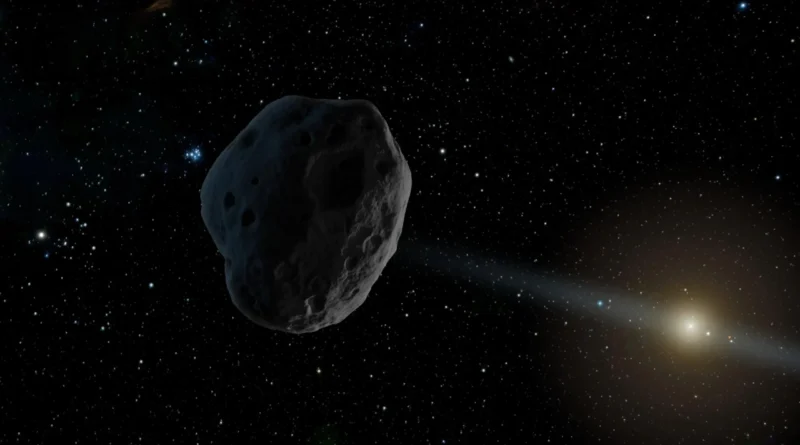
For nearly three decades, astronomers believed 1998 SH2 was an ordinary near-Earth asteroid. New research has now changed that understanding. After studying its unusual movement and capturing fresh telescope images, scientists have confirmed that the object is actually a weakly active comet.
The finding does not indicate any new danger to Earth. Instead, it gives researchers a better understanding of how some space objects behave and could improve future methods of tracking objects that pass close to our planet.
What Happened?
NASA-led researchers discovered that the object known as 1998 SH2, first identified in 1998, was behaving differently from a typical asteroid.
When astronomers attempted to track it during its close approach to Earth in 2025, they found that it was not exactly where their calculations predicted. The difference was small but significant enough to suggest that gravity alone could not explain its motion.
Further observations using powerful telescopes in Hawaii and Chile detected a faint tail of dust behind the object—a defining feature of a comet. Based on this evidence, scientists have now classified it as an active comet while retaining its historical asteroid designation. It has also received the provisional comet designation P/1998 SH2.
How Credible Is This Discovery?
The discovery is supported by multiple independent sources and is considered highly credible.
The research was led by scientists at NASA’s Jet Propulsion Laboratory and published in the peer-reviewed journal Nature Astronomy. The conclusion is based on years of orbital observations along with new telescope images collected from internationally recognized observatories.
At present, there are no major scientific disagreements over the object’s updated classification.
Why Was 1998 SH2 Misidentified?
Asteroids and comets are usually easy to distinguish.
- Asteroids are mostly rocky or metallic objects.
- Comets contain frozen ice mixed with rock and dust. As they approach the Sun, the ice heats up and releases gas and dust, creating a visible tail.
In the case of 1998 SH2, the comet’s activity is extremely weak. Earlier observations did not detect any visible tail, making it appear similar to an asteroid.
Researchers found that small amounts of escaping gas were acting like tiny natural rocket engines, slightly changing the object’s path around the Sun. These subtle forces eventually revealed its true identity.
Why Does This Matter?
Although this discovery does not change Earth’s immediate safety, it has important scientific value.
Space agencies constantly monitor thousands of near-Earth objects to understand their future paths. If an object behaves like a comet instead of an asteroid, its orbit can slowly change because of gas escaping from its surface.
Recognizing these small changes allows scientists to produce more accurate predictions of future trajectories and improves long-term planetary defense planning.
The finding also suggests that some objects currently listed as asteroids may actually be weak comets that have gone unnoticed.
Who Benefits From This Discovery?
Several scientific fields could gain from this research.
Scientists
- Better understanding of how small bodies evolve within the Solar System.
- Improved methods for identifying unusual near-Earth objects.
Planetary Defense Programs
- More accurate orbital calculations for potentially hazardous objects.
- Better long-term risk assessment.
Future Space Missions
- More reliable information when selecting targets for exploration or sample-return missions.
For the general public, there is no immediate practical impact, but the research contributes to safer and more accurate monitoring of Earth’s cosmic neighborhood.
Could This Change Future Space Research?
Possibly.
Researchers believe this discovery could encourage astronomers to re-examine other near-Earth objects that currently appear inactive but display unexplained orbital changes.
Future surveys using more sensitive telescopes may identify additional weak comets hiding among known asteroid populations.
If more such objects are found, scientists may refine current classification systems and improve computer models used to predict orbital behavior.
How Are Experts Responding?
Astronomers describe the discovery as an example of how long-term observations can change scientific understanding.
Rather than relying only on how an object looks through a telescope, researchers increasingly combine precise orbital measurements with advanced imaging techniques to determine its true nature.
The study also highlights the importance of international collaboration, with observatories in different countries contributing evidence that confirmed the object’s cometary activity.
What Should Readers Expect Next?
Scientists are expected to continue monitoring 1998 SH2 during future passes near Earth.
Researchers will also search for similar objects whose motion cannot be fully explained by gravity alone. As telescope technology improves, additional hidden comets may be discovered among objects previously classified as asteroids.
There is currently no indication that 1998 SH2 poses a new impact threat to Earth. The discovery primarily improves scientific knowledge rather than signaling any immediate risk.
Key Takeaways
- Scientists have confirmed that near-Earth object 1998 SH2 is a weakly active comet rather than a typical asteroid.
- The discovery is supported by NASA-led research and a peer-reviewed scientific study, making it a well-established finding.
- The research improves understanding of near-Earth objects and could strengthen future planetary defense efforts by helping astronomers identify similar hidden comets.