Ryanair Flight Makes Emergency Return After Mid-Air Window Failure: What Happened and Why It Matters
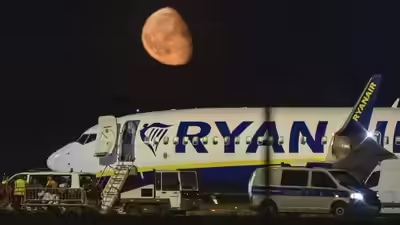
A Ryanair flight from Greece to Germany was forced to return shortly after take-off following a serious mid-air emergency in which a passenger window became dislodged. The incident left one passenger partially pulled outside the aircraft during rapid cabin depressurization before fellow travelers helped bring him back inside.
While the aircraft landed safely and no fatalities were reported, the event has triggered a fresh investigation into what caused the failure and renewed attention on aviation safety standards.
What Happened During the Flight?
The incident occurred on a Boeing 737-800 operating a Ryanair service from Thessaloniki, Greece, to Memmingen, Germany. Shortly after departure, passengers reported hearing a loud bang before oxygen masks dropped from the ceiling.
According to Ryanair, a passenger window became dislodged during flight, forcing the crew to declare an emergency and return to Thessaloniki. The aircraft landed safely, and passengers were taken back to the terminal. One passenger received medical treatment after landing.
Multiple news agencies reported that the injured passenger, seated next to the damaged window, was partially pulled through the opening because of the sudden loss of cabin pressure. Other passengers reportedly helped hold and pull the individual back into the cabin until the aircraft landed.
A replacement aircraft later completed the journey to Germany.
How Credible Is This Information?
The emergency landing itself has been officially confirmed by Ryanair.
However, the exact reason why the window became dislodged remains under investigation.
Some local media reports suggested that debris from an engine failure may have struck the window, leading to rapid decompression. Reuters reported that industry sources relayed similar information, but authorities have not yet issued a final conclusion. Investigators are continuing to examine the aircraft, meaning the suspected cause should still be treated as preliminary rather than confirmed.
Understanding Cabin Depressurization
Commercial aircraft fly at altitudes where outside air pressure is too low for passengers to breathe normally. Aircraft cabins are therefore pressurized to create a safe environment.
If a window or another part of the aircraft structure suddenly fails:
- Cabin pressure drops rapidly.
- Oxygen masks deploy automatically.
- Pilots descend quickly to a lower altitude where breathing becomes safer.
- Emergency procedures are followed before the aircraft lands.
Although such events are dramatic, modern airline crews are extensively trained to respond to rapid depressurization emergencies.
Why This Incident Matters
Serious structural failures on modern commercial aircraft are extremely rare.
Because of that, every such incident receives detailed scrutiny from aviation regulators and manufacturers. Investigators will examine:
- Whether the window failure resulted from structural damage.
- Whether an engine malfunction contributed to the incident.
- Maintenance records of the aircraft.
- Whether additional inspections are needed across similar aircraft.
The findings could influence future inspection procedures if investigators identify a broader safety concern.
Who Is Affected?
Passengers
Those onboard experienced a frightening emergency despite the safe landing. Incidents of this nature can also affect passenger confidence in air travel.
Ryanair
The airline will face operational disruption, investigation costs and increased public scrutiny, even though it maintained that the aircraft landed safely and arranged an alternative flight for passengers.
Boeing and Engine Manufacturers
Because the aircraft involved is a Boeing 737-800, investigators will also examine whether any manufacturing or mechanical issue contributed to the incident. Boeing has indicated it is assisting with the investigation.
Aviation Regulators
Authorities will review evidence to determine whether this was an isolated mechanical failure or something requiring wider regulatory action.
Could This Lead to Safety Changes?
At this stage, no new safety directives have been announced.
However, depending on the investigation’s conclusions, authorities could recommend:
- Additional inspections of similar aircraft.
- Changes to maintenance procedures.
- Technical modifications if a design issue is identified.
- Updated operational guidance for airlines.
These decisions typically follow months of technical analysis rather than immediate public reaction.
Expert Perspective
Aviation specialists frequently note that commercial aviation remains one of the safest forms of transportation because aircraft are built with multiple layers of safety systems and strict maintenance requirements.
They also point out that emergency procedures—including rapid descent, oxygen mask deployment and diversion to the nearest suitable airport—are specifically designed for situations involving cabin pressure loss.
The fact that the aircraft landed safely demonstrates that those emergency systems functioned as intended, even though the underlying cause remains under investigation.
What Happens Next?
Investigators will inspect the damaged aircraft, review maintenance records and analyze evidence from the flight.
Authorities are expected to determine:
- Whether engine damage caused the window failure.
- Whether maintenance issues played any role.
- Whether similar aircraft require additional inspections.
- Whether any safety recommendations should be issued.
Until investigators release their findings, any explanation for the root cause remains provisional.
Key Takeaways
- A Ryanair flight returned safely to Greece after a passenger window became dislodged during flight, causing rapid cabin depressurization and injuring one passenger.
- The emergency landing is confirmed, but the precise cause of the window failure has not yet been established and remains under official investigation.
- The investigation’s findings will determine whether the incident was an isolated mechanical failure or whether broader aviation safety measures are needed.