Congress Invites Mamata Banerjee to Martyrs’ Day Event, But Puts a Political Condition
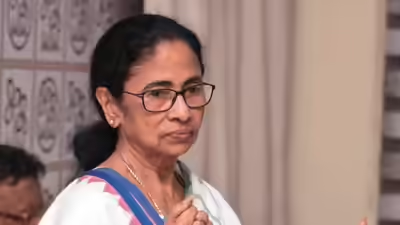
The West Bengal Congress has invited Trinamool Congress (TMC) leader Mamata Banerjee to attend its July 21 Martyrs’ Day programme. However, the invitation comes with a condition that has quickly become the centre of political discussion.
Congress leaders have said Banerjee should publicly acknowledge that leaving the Congress nearly three decades ago was a political mistake if she wishes to join the event. The statement has once again brought attention to the long and complicated relationship between the Congress and the TMC in West Bengal.
What Happened?
West Bengal Congress president Subhankar Sarkar announced that Mamata Banerjee is welcome to attend the party’s Martyrs’ Day observance on July 21. At the same time, he argued that she should admit that quitting the Congress in the late 1990s was the wrong political decision.
According to Congress leaders, the July 21 movement belongs to the Congress because it began when Mamata Banerjee was leading the Youth Congress. They argue that the historical legacy of the protest should remain associated with the party that organised it.
Why Is July 21 Politically Important?
July 21 marks the anniversary of the 1993 protest in Kolkata during which 13 Youth Congress workers were killed in police firing while demanding mandatory voter identity cards.
At that time, Mamata Banerjee was a prominent Congress leader. A few years later, she left the party and founded the Trinamool Congress (TMC), which eventually became the dominant political force in West Bengal.
For many years, the TMC’s annual July 21 rally has grown into one of the state’s biggest political events, while the Congress has continued to observe the day separately.
How Credible Is This Development?
This is a confirmed political development.
The invitation and the accompanying condition were publicly stated by West Bengal Congress president Subhankar Sarkar during preparations for the July 21 programme. Multiple news organisations have reported the statement.
However, there has been no indication that Mamata Banerjee has accepted the invitation or agreed with the Congress’s condition. At the time of writing, no official response from her has been reported.
Why Does This Matter?
The development is significant because it highlights the continuing political rivalry between the Congress and the TMC despite their occasional cooperation at the national level against the BJP.
The disagreement is not simply about attending a memorial event. It reflects a deeper debate over:
- The political ownership of the 1993 movement.
- Mamata Banerjee’s decision to leave the Congress and establish the TMC.
- Leadership and opposition politics in West Bengal.
The timing is also important because West Bengal’s political landscape has become increasingly competitive, with multiple parties seeking to strengthen their position ahead of future elections.
Different Political Perspectives
Congress’s Position
The Congress maintains that:
- The July 21 movement was originally organised under its banner.
- Its historical role should not be forgotten.
- Mamata Banerjee should acknowledge her departure from the Congress as a political mistake if she wants to participate in the Congress programme.
TMC’s Position
As of now, there has been no official indication that Mamata Banerjee intends to accept the invitation or fulfil the condition set by the Congress.
The TMC continues to organise its own July 21 observance and remains focused on its separate political programme. The party is also dealing with legal and administrative issues related to permissions for its annual rally.
Who Could Be Affected?
Political Parties
- Congress may seek to reinforce its historical connection to the 1993 movement.
- TMC is likely to continue presenting itself as the primary political successor to that legacy.
Voters
Supporters of both parties may see renewed debate over political history and leadership in West Bengal.
Opposition Politics
The episode illustrates that while opposition parties may cooperate on certain national issues, regional political rivalries remain strong and continue to shape state-level politics.
Could This Lead to Bigger Political Changes?
In the short term, the development is unlikely to alter existing political alignments.
However, it may:
- Renew public discussion about the origins of the TMC.
- Intensify political messaging before future elections.
- Encourage both parties to highlight their historical contributions to West Bengal’s political movements.
Whether this has any lasting electoral impact will depend on how both parties frame the issue in the coming weeks.
What Should Readers Expect Next?
Readers should watch for:
- Any official response from Mamata Banerjee.
- The final plans for the separate July 21 programmes.
- Whether political exchanges between the Congress and the TMC become sharper as the event approaches.
Unless either side changes its position, the two parties are expected to continue observing the anniversary independently while maintaining their differing interpretations of its political legacy.
Key Takeaways
- The West Bengal Congress has invited Mamata Banerjee to its July 21 Martyrs’ Day programme but says she should first publicly acknowledge that leaving the Congress was a mistake.
- The issue goes beyond a public invitation and reflects a long-standing dispute over political history and leadership in West Bengal.
- Mamata Banerjee has not officially accepted the invitation, and attention will now shift to how both parties mark the politically significant anniversary.