Indian Air Force Ranked Third in WDMMA Global Air Power List: What the Ranking Means and Why It Matters
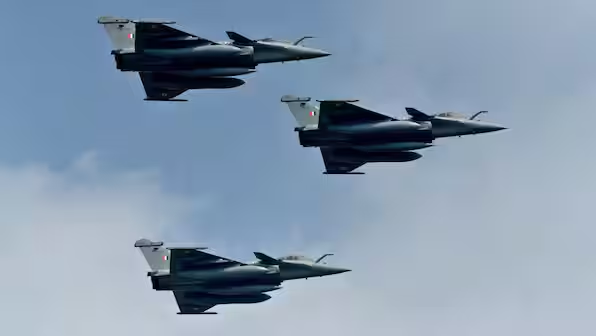
The Indian Air Force (IAF) has been placed third in the latest global air power rankings published by the World Directory of Modern Military Aircraft (WDMMA). The ranking has drawn attention because it places India ahead of China’s People’s Liberation Army Air Force (PLAAF), continuing a trend seen in recent editions of the assessment.
While the result highlights India’s air combat capabilities, defence experts caution that such rankings should be viewed as one of many assessments rather than a definitive measure of military strength.
What Happened?
The WDMMA’s latest Global Air Powers Ranking places the Indian Air Force in the third position worldwide, behind only the United States and Russia. The report evaluates military air services using its proprietary “TrueValue Rating” (TvR), which considers multiple factors beyond the total number of aircraft.
According to the organisation, the ranking is based on factors including:
- Aircraft quality and combat capability
- Fleet balance and diversity
- Modernisation levels
- Logistics and operational support
- Pilot training and force experience
- Transport, surveillance and special-mission aircraft
- Future aircraft already on order
The methodology aims to measure overall combat effectiveness rather than simply counting aircraft.
How Credible Is This Ranking?
The ranking is based on an assessment published by the World Directory of Modern Military Aircraft, an independent defence reference platform that tracks military aviation worldwide. The organisation publicly explains the factors it uses to calculate its ratings.
However, it is important to understand what the ranking does—and does not—represent.
Confirmed Facts
- WDMMA has officially released the ranking.
- India is placed ahead of China’s air force in the latest edition.
- The methodology evaluates qualitative and operational factors in addition to fleet size.
Important Context
Military capability rankings vary depending on the organisation conducting the assessment. Different institutions use different criteria, such as defence spending, technological sophistication, logistics, combat readiness, or classified intelligence that may not be publicly available.
As a result, no single ranking should be considered the final word on the actual balance of military power.
Why India’s Position Matters
Air power plays a critical role in modern defence by supporting border security, surveillance, rapid deployment, humanitarian operations and deterrence.
India’s placement reflects years of investment in improving its air combat capability through:
- Induction of newer fighter aircraft
- Expansion of surveillance and transport capabilities
- Improved training and operational readiness
- Greater emphasis on indigenous aerospace manufacturing
The ranking also comes at a time when many countries in Asia are modernising their air forces amid changing regional security dynamics.
Why Aircraft Numbers Alone Don’t Tell the Whole Story
One of the report’s central arguments is that having more aircraft does not automatically translate into greater combat capability.
For example, an air force may have:
- Older aircraft requiring replacement
- Limited support infrastructure
- Fewer specialised aircraft
- Lower operational readiness
Conversely, a smaller but modern and well-supported fleet may perform more effectively in many scenarios.
This explains why WDMMA’s rankings may differ from lists based solely on aircraft inventory.
What Does This Mean for India and China?
The ranking has attracted attention because it places India ahead of China despite China operating a larger number of aircraft.
According to WDMMA, qualitative factors—including fleet composition, logistics, operational balance and capability—contribute significantly to the final score rather than sheer numerical strength.
That said, defence analysts generally note that both India and China continue to modernise their air forces rapidly. Each country is investing in advanced fighters, drones, missiles and indigenous aerospace programmes.
Therefore, this ranking should not be interpreted as a prediction of the outcome of any future conflict.
Who Is Affected?
India
The ranking may reinforce confidence in the country’s ongoing defence modernisation efforts and support continued investment in aerospace capability.
Defence Industry
Indian aerospace manufacturers and defence suppliers could benefit from sustained policy focus on indigenous production and advanced aircraft development.
Regional Security
Neighbouring countries closely monitor such assessments, although military planning relies on far more detailed intelligence than publicly available rankings.
What Challenges Still Remain?
Despite the positive ranking, several defence observers have pointed out that India’s air force continues to face capability gaps.
These include:
- The need to replace ageing aircraft
- Maintaining desired fighter squadron strength
- Faster induction of indigenous platforms
- Continued investment in advanced technologies and support infrastructure
Recent reporting also notes that while the ranking is encouraging, addressing these gaps remains important for long-term operational readiness.
What Could Happen Next?
The ranking is unlikely to trigger immediate policy changes on its own.
However, it may contribute to ongoing discussions about:
- Accelerating aircraft procurement
- Expanding domestic defence manufacturing
- Investing in next-generation aviation technologies
- Strengthening long-term air force modernisation plans
Future editions of the ranking will likely reflect how countries adapt to evolving technologies such as unmanned systems, artificial intelligence and advanced combat aircraft.
Key Takeaways
- The Indian Air Force has been ranked third globally in WDMMA’s latest Global Air Powers Ranking, behind the United States and Russia, and ahead of China’s air force.
- The ranking measures overall combat effectiveness using multiple qualitative factors rather than aircraft numbers alone, making it different from simple fleet-size comparisons.
- While the assessment highlights India’s growing air power, it should be viewed as one analytical benchmark rather than a definitive measure of global military capability.