Ebola Outbreak in DR Congo: Why the First Bundibugyo Vaccine Trial Could Be a Turning Point
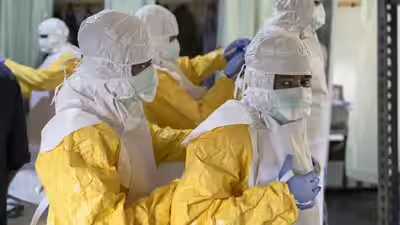
The Democratic Republic of the Congo (DRC) is battling a deadly Ebola outbreak caused by the rare Bundibugyo strain of the virus. As the death toll has crossed 700, researchers have launched the world’s first human clinical trial of a vaccine designed specifically for this strain.
While the development offers hope, experts caution that the vaccine is still in its earliest testing phase. For now, the outbreak continues to rely mainly on public health measures, patient care, and ongoing research to reduce infections and save lives.
What Has Happened?
Health authorities have confirmed that the current Ebola outbreak in the Democratic Republic of the Congo has resulted in more than 1,900 confirmed infections and over 700 deaths. The disease has also spread into neighbouring Uganda, increasing concerns about cross-border transmission.
Unlike previous Ebola outbreaks caused by the Zaire strain, this emergency involves the Bundibugyo strain, for which there is currently no approved vaccine or targeted treatment. That gap has made disease control significantly more challenging.
First Human Trial of a Bundibugyo Ebola Vaccine Begins
Researchers at the University of Oxford have started the first Phase I clinical trial of a vaccine developed specifically against the Bundibugyo strain.
This early-stage study will involve around 50 healthy adult volunteers. The primary objective is to determine whether the vaccine is safe and capable of producing an immune response. It is not intended to measure how well the vaccine prevents disease in the wider population at this stage.
If the trial produces encouraging safety results, researchers would still need to complete additional clinical phases before regulators consider approval for wider use. That means there is currently no confirmed timeline for public availability.
How Credible Is This Development?
This is a confirmed scientific development.
The vaccine trial has been officially announced by the University of Oxford and is supported by recognised international research partners. The outbreak itself is being monitored by the World Health Organization (WHO), national health authorities, and humanitarian organisations working in affected regions.
Although case numbers may change as surveillance improves, there is broad agreement among health agencies that the outbreak remains serious and requires sustained international support. WHO has also warned that actual infections may be higher than officially reported because many cases occur in remote areas with limited healthcare access.
Understanding the Bundibugyo Ebola Virus
Ebola is a severe viral disease that spreads through direct contact with the bodily fluids of infected people or contaminated materials. Symptoms often begin with fever, weakness, headaches and muscle pain before progressing to vomiting, diarrhoea and, in severe cases, internal and external bleeding.
The Bundibugyo strain is much less common than the Zaire strain responsible for several previous Ebola outbreaks. Because relatively few outbreaks have occurred, scientists have had limited opportunities to develop vaccines or treatments specifically targeting it.
That makes the current vaccine research particularly important for future outbreak preparedness.
Why This Matters Beyond Central Africa
Although the outbreak is centred in the Democratic Republic of the Congo, infectious diseases rarely remain confined by national borders.
Several factors make this outbreak globally significant:
- Cross-border movement has already resulted in confirmed cases in Uganda.
- International travel increases the importance of rapid detection and containment.
- A successful vaccine could strengthen global preparedness for future outbreaks involving rare Ebola strains.
- Lessons learned may improve emergency responses to other emerging infectious diseases.
The outbreak also highlights continuing inequalities in healthcare infrastructure, surveillance systems and access to life-saving medical resources across lower-income countries.
Who Is Most Affected?
The immediate burden falls on communities living in affected regions of eastern DR Congo.
Those facing the greatest risk include:
- Patients infected with the virus.
- Family members and close contacts.
- Doctors, nurses and frontline healthcare workers.
- Humanitarian aid organisations responding to the crisis.
- Local economies disrupted by illness, travel restrictions and reduced commercial activity.
Neighbouring countries also face increased pressure to strengthen disease surveillance and border screening to prevent wider spread.
Challenges Facing the Response
Developing a vaccine is only one part of controlling an Ebola outbreak.
Public health officials continue to face several obstacles:
- Limited healthcare facilities in affected regions.
- Difficulty identifying and monitoring close contacts.
- Funding shortages for emergency response programmes.
- Logistical challenges in reaching remote communities.
- The absence of approved therapies specifically designed for the Bundibugyo strain.
WHO has indicated that current funding remains well below the level required for an effective outbreak response, making international cooperation increasingly important.
What Could Change in the Coming Months?
Immediate Outlook
Health authorities are expected to continue focusing on:
- Isolation of confirmed cases.
- Contact tracing.
- Community awareness campaigns.
- Supportive medical treatment.
- Ongoing vaccine and treatment research.
Longer-Term Impact
If the vaccine proves both safe and effective through multiple clinical trial phases, it could become the first approved vaccine specifically targeting the Bundibugyo strain.
That would improve preparedness for future outbreaks and expand the global toolbox for responding to Ebola emergencies. However, experts emphasise that this remains a long-term possibility rather than an immediate solution.
Expert Perspective
Public health experts generally view the launch of the vaccine trial as an encouraging scientific milestone rather than a breakthrough that will immediately stop the outbreak.
They stress that vaccination research must continue alongside established outbreak-control measures such as rapid diagnosis, patient isolation, community engagement and international coordination.
At the same time, WHO continues to call for greater financial and operational support to prevent the outbreak from expanding further.
What Should Readers Expect Next?
The next major updates are likely to focus on:
- Early safety findings from the Phase I vaccine trial.
- Changes in outbreak case numbers.
- Progress in separate clinical trials evaluating potential treatments.
- Additional international funding and public health support for affected regions.
Until stronger evidence becomes available, health authorities are expected to continue relying primarily on surveillance, infection control and supportive care rather than vaccination.
Key Takeaways
- The Democratic Republic of the Congo is facing a severe Ebola outbreak caused by the rare Bundibugyo strain, with more than 700 reported deaths.
- The world’s first human clinical trial of a Bundibugyo-specific vaccine has officially begun, but it remains in the earliest stage of testing and is not yet ready for public use.
- Scientists see the trial as an important step for future outbreak preparedness, while health officials continue to emphasise containment, treatment and international support as the immediate priorities.