Indian Crew Member Killed in Strait of Hormuz Tanker Strike: Why the Incident Matters Beyond the Immediate Tragedy
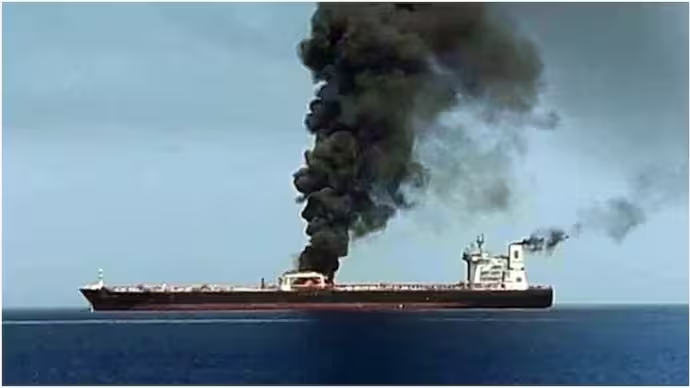
The death of an Indian crew member and injuries to several others after missile strikes on two UAE-linked oil tankers have drawn international attention to the growing security risks in the Strait of Hormuz. The incident comes at a time of rising military tensions in West Asia, raising fresh concerns over commercial shipping, global energy supplies and the safety of foreign maritime workers.
What Happened?
According to the United Arab Emirates (UAE) Ministry of Defence, two UAE national tankers—Mombasa and Al Bahiyah—were struck by Iranian cruise missiles while passing through the southern shipping lane of the Strait of Hormuz in Omani territorial waters.
The attack killed one Indian crew member and injured eight others, including six Indian nationals and two Ukrainian nationals. Officials said four of the injured sustained serious wounds. Fires broke out on both vessels but were later brought under control, preventing further damage.
How Credible Is This News?
This is a confirmed development based on official statements from the UAE Ministry of Defence. The casualty figures have also been reported by multiple international news organisations, including Reuters.
Iran has acknowledged targeting the vessels during the broader military confrontation in the region, although different parties continue to disagree over the legal and strategic justification for the attack. As with many developments during an active conflict, further official updates could alter the available information.
Why Is the Strait of Hormuz So Important?
The Strait of Hormuz is one of the world’s most strategically important maritime routes. It connects the Persian Gulf with the Gulf of Oman and the Arabian Sea, serving as a major passage for international oil and natural gas shipments.
Because a significant share of global energy exports travels through this narrow waterway, any military confrontation in the area can quickly affect:
- International oil prices
- Shipping costs
- Marine insurance premiums
- Supply chains across Asia, Europe and beyond
Even short-term disruptions often create uncertainty in global financial and energy markets.
Why Does This Matter for India?
Although the targeted ships were UAE-operated rather than Indian-owned, the incident has direct relevance for India.
India is one of the world’s largest suppliers of merchant seafarers, with thousands of Indian nationals working aboard commercial vessels operated by international shipping companies. As a result, regional conflicts can place Indian citizens at risk even when India is not directly involved in the dispute.
The incident also highlights India’s broader interest in maintaining safe international shipping routes because the country depends heavily on imported crude oil moving through West Asian sea lanes.
Who Is Most Affected?
Several groups are likely to feel the impact of the incident.
Directly affected
- Families of the deceased and injured crew members
- Merchant sailors working in conflict-prone waters
- Shipping companies operating through the Gulf
Economically affected
- Oil-importing countries facing higher transportation costs
- Energy markets reacting to geopolitical uncertainty
- Businesses dependent on stable global supply chains
Politically affected
- The UAE, which has condemned the strike as a violation of international law
- Iran, which remains involved in an expanding regional military confrontation
- Countries relying on freedom of navigation through the Strait of Hormuz
Background: Why Have Tensions Increased?
The tanker strike occurred amid an escalating confrontation involving Iran and the United States. Recent military operations by both sides have intensified security concerns across the Gulf region.
Commercial vessels passing through the Strait of Hormuz now face greater operational risks, increasing pressure on governments and shipping companies to strengthen maritime security while avoiding a wider regional conflict.
What Could Happen Next?
Several immediate developments are possible if tensions continue.
- Governments may increase naval patrols to protect commercial shipping.
- Shipping companies could reroute vessels where feasible, although alternatives are limited.
- Insurance costs for ships operating in the Gulf may rise.
- Oil markets could remain volatile if further attacks occur.
- Diplomatic efforts may intensify to prevent additional disruption to one of the world’s busiest energy corridors.
The longer-term outlook will largely depend on whether military activity in the region escalates or diplomatic negotiations succeed in reducing tensions.
How Are Different Stakeholders Responding?
The UAE has strongly condemned the attack, describing it as a serious violation of international law and stating that it reserves the right to take measures necessary to protect its security and sovereignty.
India has begun responding through diplomatic channels following the death of its citizen, reflecting the government’s concern for the safety of Indian nationals working overseas.
Meanwhile, international observers continue to monitor the impact of the confrontation on regional stability, maritime security and global energy markets.
Analysis: Why This Incident Has Wider Implications
Analysis: Beyond the immediate human tragedy, the strike illustrates how modern geopolitical conflicts increasingly affect civilian shipping and multinational crews rather than only military targets.
For countries such as India, whose citizens play a major role in the global maritime workforce, conflicts far from home can still have direct human and economic consequences.
The incident also reinforces the strategic importance of keeping major international shipping routes open. Any sustained disruption in the Strait of Hormuz has the potential to influence fuel prices, freight costs and inflation well beyond the Middle East.
While governments are likely to focus on preventing further escalation, commercial shipping companies and energy markets may continue operating under heightened caution until regional tensions ease.
Key Takeaways
- One Indian crew member was killed and several others injured after missile strikes hit two UAE tankers transiting the Strait of Hormuz, according to UAE authorities.
- The incident highlights growing security risks in one of the world’s most important energy shipping routes and could contribute to continued volatility in global oil and maritime markets.
- The situation remains fluid, and further diplomatic, military and economic developments are expected as regional tensions continue to evolve.