Japan Considers Expanding Pension Fund Investments Beyond Traditional Assets
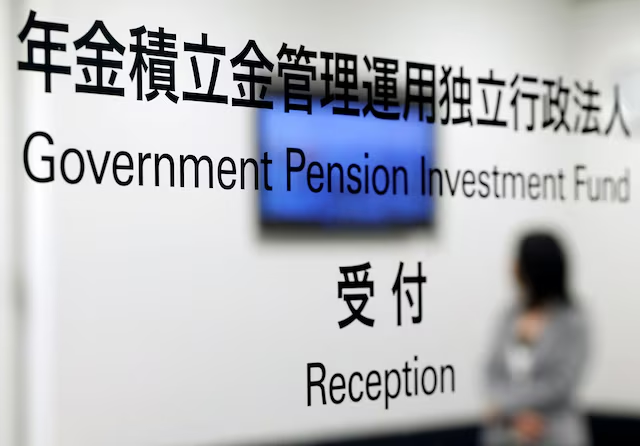
Japan is preparing to broaden the investment strategy of the world’s largest public pension fund by increasing its exposure to alternative assets such as private companies and real estate, according to a report by the Nikkei newspaper. If implemented, the move would mark another step in the country’s wider effort to diversify pension investments while supporting long-term financial stability.
The proposal comes just days after Japanese officials signaled they wanted major state-backed pension funds to invest more heavily in domestic financial assets, a statement that immediately influenced currency and bond markets.
What Has Happened?
The latest development involves Japan’s Government Pension Investment Fund (GPIF), which manages roughly $1.8 trillion in retirement savings, making it the largest pension fund globally. According to the Nikkei report, a government panel is expected to recommend increasing the share of “alternative investments” in the fund’s portfolio closer to the current maximum limit of 5%.
Alternative investments include assets that do not trade regularly on stock exchanges, such as:
- Private equity (investments in privately owned companies)
- Real estate
- Infrastructure projects
- Other long-term investment vehicles
These differ from traditional investments like publicly listed stocks and government or corporate bonds.
At the end of March, alternative assets represented only 1.7% of GPIF’s holdings, leaving considerable room within the existing investment limit.
How Credible Is This Report?
The information is credible but not yet officially confirmed.
The report originated from Japan’s respected financial newspaper Nikkei, while Reuters independently reported its contents. However, the Ministry of Health, Labour and Welfare—which oversees GPIF—had not publicly commented on the proposal when the report was published.
This means:
- The proposal has been reported by established news organisations.
- It appears to be under active government consideration.
- Final approval or implementation has not yet been officially announced.
Why Is Japan Looking Beyond Stocks and Bonds?
Large pension funds typically spread investments across multiple asset classes to reduce risk over long periods.
Traditional portfolios usually consist of:
- Domestic shares
- Overseas shares
- Government bonds
- Corporate bonds
Alternative assets can offer additional diversification because their performance does not always move in line with stock or bond markets.
Supporters argue that carefully increasing exposure to these assets could help improve long-term returns while reducing overall portfolio volatility.
The discussion also comes amid broader efforts by Japanese policymakers to strengthen domestic financial markets and respond to prolonged pressure on the yen. Earlier this week, Finance Minister Satsuki Katayama said the government wanted state pension funds to increase investments in Japanese assets, comments that contributed to gains in the yen and Japanese government bonds.
Why Does This Matter?
Because GPIF manages retirement savings on an enormous scale, even relatively small changes in its investment strategy can influence financial markets.
Potential implications include:
- Increased demand for private investment opportunities.
- Greater funding for infrastructure and long-term business projects.
- Continued diversification of Japan’s public pension assets.
- Possible shifts in how other institutional investors allocate their portfolios.
Given GPIF’s size, its investment decisions are closely monitored not only in Japan but also by global financial markets.
Who Could Benefit?
Several groups could see advantages if the proposal moves forward.
Potential beneficiaries include:
- Private equity firms seeking institutional capital.
- Real estate and infrastructure investment sectors.
- Companies looking for long-term investors.
- Pension managers aiming to diversify investment risk.
For pension beneficiaries, the objective would be to improve long-term investment performance while maintaining prudent risk management.
Who Could Face Challenges?
Alternative investments also bring trade-offs.
These assets are generally:
- Less liquid than publicly traded stocks.
- Harder to value because they do not trade daily.
- Longer-term commitments that may be more difficult to sell quickly.
Critics often argue that increasing exposure to private assets requires careful oversight, particularly when managing public retirement savings. Supporters, however, say limited allocations can strengthen portfolio diversification without fundamentally increasing overall risk.
How Are Markets and Policymakers Responding?
Financial markets have already reacted positively to Japan’s broader pension investment discussions.
Following recent government comments encouraging more domestic investment, the yen strengthened and Japanese government bond prices rose as investors anticipated stronger domestic capital flows.
The latest proposal could attract additional attention from investors watching whether GPIF expands its investment strategy beyond traditional markets.
Government officials are expected to continue reviewing recommendations from the advisory panel before any formal policy changes are introduced.
What Should Readers Expect Next?
Several developments will determine the proposal’s future:
- The government panel is expected to release its recommendations.
- GPIF will evaluate whether any portfolio adjustments align with its long-term investment mandate.
- Officials may provide further clarification on how any changes would be implemented.
- Investors will monitor whether the proposal remains focused on diversification rather than broader policy objectives.
Until an official decision is announced, the reported changes should be viewed as a proposal rather than a confirmed policy.
Key Takeaways
- Japan is reportedly considering increasing the share of alternative investments within the world’s largest public pension fund, GPIF.
- The proposal remains under consideration and has not yet been formally confirmed by the ministry overseeing the fund.
- Because GPIF manages around $1.8 trillion in assets, even modest changes to its investment strategy could have significant implications for Japan’s financial markets and long-term pension management.